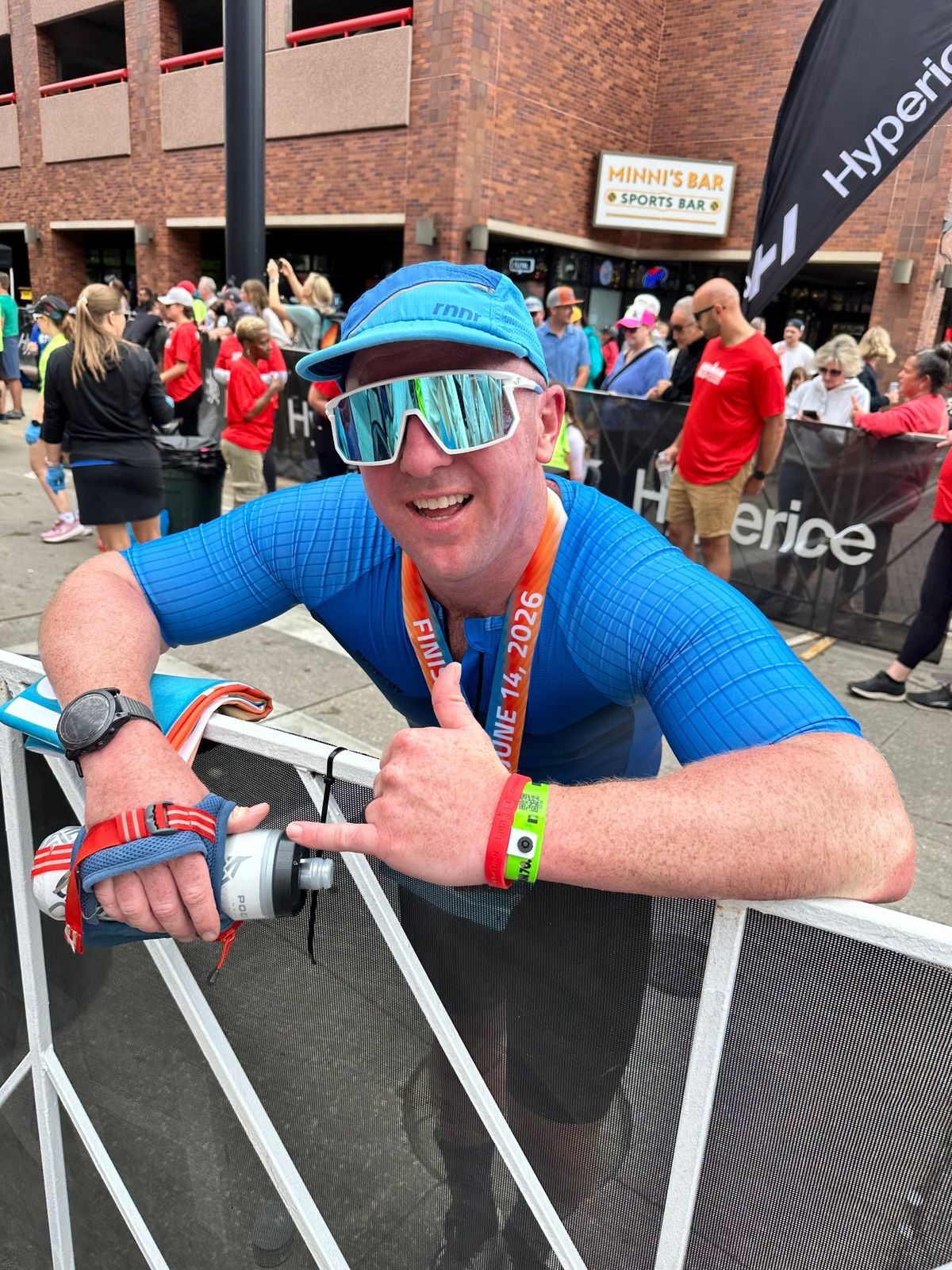
You finished an Ironman. The bike felt controlled. You executed your plan. Then the run unraveled.
The natural conclusion is: I need to work on my run! But do you? Or did you just experience the triathlon paradox? The paradox is this: the Ironman run is performed in a metabolically and mechanically constrained state that cannot be replicated by fresh running.
The short answer: your Ironman marathon is decided mostly on the bike. The run happens under fatigue that fresh running can’t replicate, so the best preparation is steady, well-fueled long rides, brick runs kept at or below race pace, and judging progress by how little you slow down, not how fast you are when fresh.
Why is the Ironman run so different from a marathon?
Unlike a standalone marathon, the Ironman run is executed under cumulative constraints imposed by cycling:
- Reduced muscle and liver glycogen
- Elevated oxygen cost at a given pace
- Impaired running economy
- Elevated core temperature
- Residual muscular damage from cycling
- Altered neuromuscular recruitment patterns
- Autonomic and hormonal stress
- Disproportionately high perceived effort (RPE) for pace
As a result, unlike fresh-state running, the Ironman marathon is not a maximal-capacity performance. It is a constraint-limited performance, governed by how much metabolic capacity can be sustained under fatigue rather than by VO₂max or fresh pace ability.
Joyner & Coyle (2008) emphasized that endurance performance is determined not solely by maximal capacity, but by the fraction of that capacity that can be sustained. In Ironman racing, swimming and cycling set the ceiling; the run reveals how much of that ceiling remains usable.
What does that mean for your training?
Improving isolated run fitness alone does not remove these constraints. Long-course success depends on preserving economy and output under fatigue.
- The bike largely determines the quality of the run.
- Low glycogen availability increases oxygen cost and reduces carbohydrate oxidation efficiency.
- Prolonged cycling degrades elastic energy return and increases reliance on less efficient muscle fibers.
- Running economy deteriorates even when pace remains unchanged.
Therefore, training must prioritize durability, not peak speed.
How should you train for the Ironman run?
Prioritize patience and fitness on the bike:
- Emphasize long rides at tightly controlled, steady power
- Avoid surges that disrupt metabolic stability
- Develop aerobic robustness, not peak power
- Implement fueling strategies that stabilize substrate availability
Keep run training event-demand specific:
- Use brick runs to express run ability under fatigue, not to build fitness
- Treat bricks as skill/form sessions, not fitness tests
- Avoid running above race pace in bricks
- Accept that race pace may feel easy early and disproportionately hard later
Measure what matters:
- Observe ability to steady power late in long rides
- Monitor heart rate drift and RPE, not pace, during fatigued runs
- Maintain cadence consistency as fatigue accumulates (on bike and run)
- Evaluate progress by resistance to decline, not peak speed
Your best Ironman marathon
Athletes who execute well are not the fastest runners in isolation. They are the ones still running steadily when others slow dramatically. Ironman run training is bike training in disguise. The objective is not to run faster when fresh, but to run well when constrained.
Keep reading
- Why Durability Matters
- Five Things You’re Missing with FTP
- 5 Powerful Decisive Points in a 70.3 Race That Competitive Triathletes Must Master
- From First 70.3 to Ironman in 33 Weeks: What It Really Takes to Achieve an Ambitious Goal
About Elizabeth Waterstraat
Elizabeth Waterstraat is the founder and head coach of Multisport Mastery, established in 2007. A USA Triathlon Level III Coach with 20 years of coaching experience and 26 years as an endurance athlete, Elizabeth works with athletes ranging from first-time triathletes to national champions and world championship qualifiers. Her coaching approach emphasizes individualized training, athlete education, consistency, and long-term development.
Looking for individualized guidance?
Our coaching combines thoughtful training, ongoing communication, and athlete education to help you pursue meaningful goals.